Europe’s energy landscape has changed dramatically in just a few years. Although the installed photovoltaic capacity continues to grow exponentially, this success is accompanied by increasing systemic challenges. The simultaneous feed-in of substantial solar and wind capacities across Europe is causing volatility on electricity exchanges and eroding the previous ‘full feed-in against fixed remuneration’ business model. Geographically situated at the heart of the European electricity interconnection network (ENTSO-E), Switzerland often acts as a focal point for developments affecting the entire continent.
The Swiss framework legislation as a regulatory framework
On 1st January 2026, the legal landscape in Switzerland underwent a fundamental change with the full implementation of the ‘Federal Act on a Secure Electricity Supply from Renewable Energies’ (Mantelerlass). This legal framework responds to the need to both promote and actively integrate decentralised generation into market and grid operations.
Until now, the feed-in tariffs of many of the more than 600 Swiss distribution network operators (DNOs) were based on the ‘avoided costs’ of procurement on the market. This resulted in significant heterogeneity. However, a new market logic has prevailed since 2026:
- Linkage to the reference market price: The feed-in tariff is now primarily based on the quarterly-averaged reference market price at the time of feed-in.
- Minimum remuneration: Lower limits have been introduced as a safety net for investors (approximately 4.5 to 8 Rp./kWh, depending on the category), ensuring that the expansion of small-scale PV systems is not stifled.
- Local Electricity Communities (LECs): This is a milestone in Swiss legislation. For the first time, it is legally possible to trade electricity via the public grid within a neighbourhood or municipality while benefiting from reduced grid usage charges.
- GO optimisation: In addition to the feed-in tariff, the strategic marketing of decoupled Guarantees of Origin (GOs) secures additional revenue and enables the targeted management of environmental benefits both at home and abroad.
Architects of the networked energy world
In the complex landscape of decentralised energy generation, the following five established players, each with their own distinct role and solutions, can be highlighted as examples:
- BKW Energie AG is a supra-regional energy and infrastructure company that generates and distributes electricity.
- Novagrid AG is a strategic partner that supports future-proof planning and the digital transformation of electricity grids while bridging the gap to successful direct marketing.
- pi-System GmbH provides software solutions for managing energy data and optimising business processes in the utilities sector.
- Solar-Log™ GmbH provides the core technology and data basis for monitoring and managing the energy in PV systems.
Today, PV installations are no longer isolated assets, but part of networked ecosystems. The key challenge in 2026 will be to bridge the gap between physical generation and economic utilisation. The solutions offered by the aforementioned companies go far beyond simply optimising self-consumption, as the combination of specialised hardware, smart software algorithms and in-depth infrastructure expertise already forms the foundation for the energy sector of tomorrow.
Only through the seamless interaction of these elements can volatile solar yields be accurately forecast, storage potential in electric mobility be fully exploited and electricity be placed on the most profitable markets in real time. In short, they are transforming photovoltaics from a purely technical generation unit into a highly controllable and value-adding market instrument.
The role of technological enablers: the example of Solar-Log™
To implement these complex models, service providers such as the aforementioned market players require a ‘ready for market’ hardware infrastructure at the grid connection point. This is where manufacturer-independent monitoring and control systems, such as those from Solar-Log™, come into play.
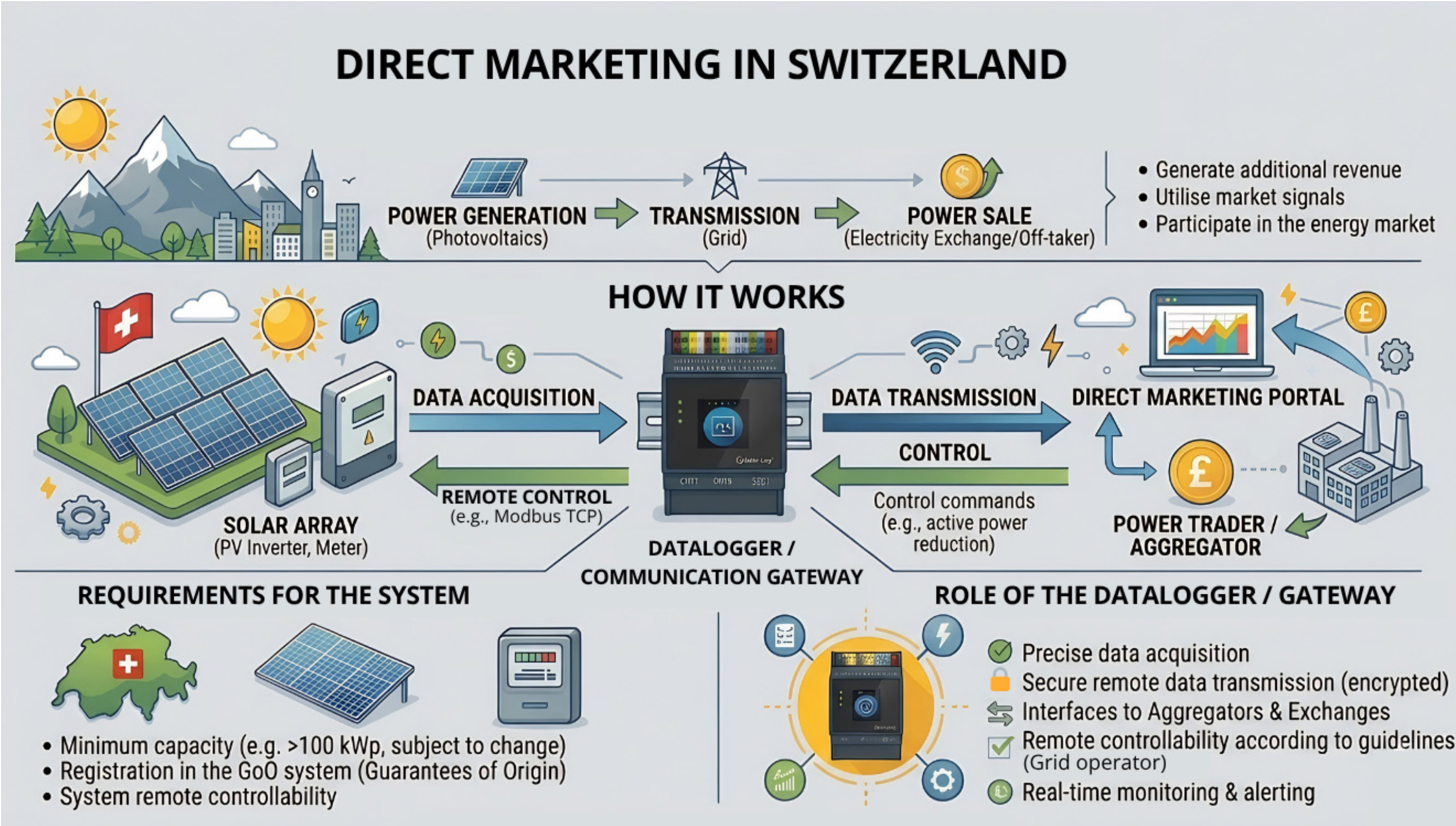
The viability of direct marketing hinges on its technical controllability. In practice, the challenge often lies in the heterogeneity of the hardware. For example, an industrial site may have inverters from various suppliers. A central gateway is required to bundle these components for direct marketing or for an LEC.
The Solar-Log™ Base acts as a smart hub here, communicating with almost all standard inverters, as well as many battery meters and sensors. The device collects all relevant system data and transmits it to the online Solar-Log WEB Enerest™ portal, where yields can be monitored and faults reported immediately.
Three technical features provided by Solar-Log™ are essential for direct marketing:
- Active power control: When electricity prices are negative, direct marketers must be able to throttle the PV system within seconds. Solar-Log™ enables this remote control via secure VPN connections.
- Real-time monitoring: Active portfolio management is impossible without precise live data. Solar-Log’s data aggregation allows Pi-Systems, for example, to identify forecast deviations immediately.
- Interface openness: Translating manufacturer-specific protocols into standards such as Modbus TCP or specialised direct marketing interfaces provides the backbone for scalability.
Europe by comparison: market integration dynamics
Developments in Switzerland reflect a Europe-wide trend, although the extent of this varies from country to country. A look at neighbouring countries reveals the different stages of market integration.
Germany: from pioneer to flexible market
Direct marketing has been mandatory in Germany for installations of 100 kW or more for several years now. Following the introduction of ‘Solar Package I’ and the planned changes for 2026, the focus has shifted significantly towards avoiding feed-in at negative prices. ‘Free offtake’ is increasingly being replaced by dynamic models that force operators to invest in storage technologies.
Germany is grappling with the paradox of significant overcapacity at midday, making smart management, such as that provided by Solar-Log™, a matter of economic survival.
Austria: pioneer in energy communities
With its Renewable Energy Expansion Act (EAG), Austria paved the way for renewable energy communities (RECs) at a very early stage. Similar to the Swiss LECs, the focus here is on local exchange.
This pioneering role will be consolidated in 2026 by the new Electricity Industry Act (ElWG), which further strengthens peer-to- peer trading and the rights of active customers. The key challenge in Austria remains achieving technical harmonisation across different grid levels. Service providers are increasingly turning to tried-and-tested Swiss models to reliably manage the growing complexity involved in billing.
Italy and Spain: overcoming ‘cannibalisation’
The phenomenon of price cannibalisation is most advanced in the sun-drenched countries of southern Europe. At midday, prices on the spot market often drop to zero.
Direct marketing without integrated load management and large-scale battery energy storage systems (BESS) is barely profitable here anymore. Technological gateways must be able to control not only PV systems, but also entire storage farms bidirectionally.